Blog Archive

Tuesday, September 21, 2021

Infrastructure, Wealth, and Low-Wage Jobs

  The Physical and the Social 

                   Infrastructure Proposals  — $4 trillion    


I realize that economics is extremely boring. But would you like to add another $20,000 to your yearly income, and not just your family but all families who earned less than $200,000 last year? Naturally, everyone would like that, but how? Now economics is not so boring. You can look at a web page from the Economic Policy Institute, the Wage Calculator, that answers “What Should You Be Making?” Approximately 90% of families or households have incomes below $200,000. The share of total national income going to the lower 90% was 13% greater in 1980 than today’s share. The 13% shift in total income is a difference of $20,000 to $40,000 for every family earning less than $200,000. The economy grew, definitely, but the benefit went to only a small fraction of families, the top 10% and especially the top 1% and 0.001%.  


The New Gilded Age”, a report from the Economic Policy Institute, finds that between 1973 and 2007 58.7% of income growth “landed in the hands of the top 1 percent of families.” While the incomes of the lower earning 99% increased by 15.4%, the incomes of the top 1% increased by 216.4%. (page 12, pdf version). During the years 1945 to 1973 the reverse was seen, the top 1% received only 4.9% of growth, their incomes grew by 34.3% while the 99% grew their incomes by 100.1%.


From the period 1945 to 1973 all income levels grew more or less at the same rate as the entire economy grew, but then there was a sea change, since 1973 only the top incomes have grown at the same rate as the entire economy’s growth rate. Income growth for the lower 90% was slow to non-existent. That’s me and you. How can we reverse the shift? The Infrastructure plans are a beginning.  


Trump tried to address this problem, but he failed, quite simply. The tax cut he passed benefitted high income households (who did not need a cut) much more than middle- and low-income households. Trickle-down doesn’t work. And the majority of jobs created since 1990 have been low-wage jobs paying between $20,000 to $35,000 per year.  


We have to start with a bottom-up strategy to achieve shared prosperity. It’s correctly called wage-led growth.  


The economy is not working well for about half of the U.S. population, and this should concern everyone.

The United Way since 2009 has published a report on poverty and hardship, the ALICE report (Asset Limited, Income Constrained, Employed). In December, 2020, in its report “On Uneven Ground” it said, “approximately 40% of American families struggle to make ends meet. In 2017, 13% of U.S. households earned below the FPL [Federal Poverty Level], and another 28% were ALICE [a total of 41%] . . . .  [They have] income above the FPL but not enough to afford the basic necessities of housing, child care, food, transportation, health care, and a smartphone plan. They live paycheck-to-paycheck. And because they earn above the FPL, they are largely ineligible for public assistance programs.” The conclusion of its report says, “half of all U.S. households could be in poverty or be ALICE by the end of the pandemic.” In 2018 in Mariposa County the ALICE status reached 42% of the population, as reported in the National Overview for that year. ALICE affected 60% of Madera County and 52% of Fresno county.


You can fairly ask what has that to do with infrastructure. The answer: about 4 million decent paying jobs will be created for the full 10 years of the proposal. This will tend to “tighten” the jobs market and raise wage income for all other workers. And the cost of living will decline because of the services provided by the two infrastructure bills.


These bills will employ low income workers. President Biden in his State of the Union message said, “Nearly 90 percent of the infrastructure jobs created in the American Jobs Plan do not require a college degree; 75 percent don’t require an associate’s degree. . . . [It’s] a blue-collar blueprint to build America.”


Though the cost sounds high, $4 trillion (over 10 years), the U.S. private savings, or “household net worth", is $136 trillion. (Flow of Funds, page 2) I am guessing that most readers are just blanking-out at that figure, $136 trillion. Try comparing $4 trillion with $136 trillion. In 2019 the GDP (annual economic product) was around $20 trillion — so $136 trillion is a lot larger, right? There is a lot of private savings, even though my share is a pittance. The ratio of wealth to annual output (GDP) has never been higher; wealth is booming but it benefits only — the rich. Not the ordinary workers who earn less than $200,000 per year. And, to lose most of the readers, total wealth in the U.S. grew by more than $78 trillion over the past 12 years, which is more than $6 trillion per year. The infrastructure cost will be $0.4 trillion per year. It should be obvious, we have an imbalance; the rich are saving too much and the poor are spending too little. 


Read this article on the internet: “Want to Expand the Economy? Tax the Rich!” by Nick Hanauer, a multi-millionaire, a serial entrepreneur. Learn that Harley Davidson is making motorcycles in Thailand, and that “Low wages and rising inequality are not symptoms of slow growth; low wages and rising inequality are the disease that cause slow growth — and inequality cannot be cured by creating even more inequality.” (He’s referring to the tax cut bill that benefitted millionaires.) It’s at the American Prospect, Summer 2018. 


When the majority of workers cannot afford to purchase the value of what they produce, the result is declining consumption, fewer well-paying jobs, lower income and less savings for the majority. This is a rule of economics that is not going to change. That decline leads to unstable families and unhealthy communities, and public services that are inadequate. We can travel far down the road of inequality before we come to a crisis; Mexico is a bad example of how inequality will destroy the quality of life. But why go down that road? Proposals to reverse this trend desperately need widespread support, including voting support. Fly the American flag with pride, but choose an effective strategy to reverse these  impoverishing trends.  


Monday, May 17, 2021

For a good summation of the "toil and trouble" of the U.S. economy, see my earlier essay of August, 2019, A Litany of Economic Woes. I have neglected this blog for about a year. I added to the Covid article during 6 months when it was new and unknown, but I continued to add on and on, and now it's mostly unreadable. Then I added a pretty good synopsis article, Poverty and Covid. Today I offer a Letter to the Editor to the local newspaper, published in May,  2021.  

___________________________________

The RAND report of September 2020 shows the shifts in income distribution over 43 years, 1975 to 2018. Most importantly, the lower-earning 90% of households lost 17% of the national income, which is valued at $3.0 trillion the economy of 2018 If distributed across the board to all households in the lower 90%, it amounts to about  $28,600 more income. My "Letter to the Editor" below speaks of the shift and the growing impoverishment of most American families. The authors of the RAND study were recently interviewed, June 1, 2021, at Pitchfork Economics. Another study from the Economic Policy Institute detail the income shift, with slightly different conclusions. They conclude that two-earner families with median wage incomes, husband and wife working full-time year-round, would gain $40,000 more income each year, had the stagnation of wages not occurred. It was a policy failure, states Lawrence Mishel and Josh Bivens, in this interview. Many other news sites are publishing the RAND study's conclusions, here's one. The graph from RAND: 

Figure 2: Distribution of Shares of Taxable Income, 1975–2018

19752018
Top 1%9%22%
90-99%25%28%
Bottom 90%67%50%

Source: Authors' calculations from U.S. Census Bureau, Current Population Survey; and World Inequality Database.

Note: Due to rounding, the 1975

______________________________________

Biden’s Recent American Rescue and Jobs and Families Plans  

(This letter (a shorter version) appeared as a guest article in the local Mariposa newspaper.)


There is controversy over the Biden program of reform, the various American Plans (Rescue, Jobs, and Families) totaling about $6 trillion in added expenses over an 8 year period. I’d like to add to the conversation some background, even though it’s a bit detailed.  


President Biden in his speech of April 28th, 2021, said that during last year, 2020, 650 billionaires increased their wealth by $1 trillion in the past 12 months. He repeated this statement twice. A trillion divided between 650 is $1.5 billion per billionaire, added to each one’s net worth. This is not income, it is unrealized stock gain, taxable only when sold (realized). 


From Biden’s speech: “At the same time, the roughly 650 Billionaires in America saw their net worth increase by more than $1 Trillion. Let me say that again. Just 650 people increased their wealth by more than $1 Trillion during this pandemic. They are now worth more than $4 Trillion. My fellow Americans, trickle-down economics has never worked.”  


Total household net worth surpassed $130 trillion in Q4 of 2020, states the Flow of Funds report of the Federal Reserve, page 2. Therefore the "average" U.S. household owns $1 million because there are 130 million households. But just 8% of U.S. adults own a million or more, states the Credit Suisse Global Wealth report (Databook, page 169). And 40% of households own 0.2% of everything; therefore the $1 million average is just a sign of the enormous wealth at the top.  


In contrast the U.S. Census’ weekly Pulse Survey reported in March, 2021, that 13% of adults could not afford food for the next week, and 31% could not afford basic expenses, as reported by the Center for Budget and Policy Priorities.


We have a growing problem of inequality, hardship and poverty, amidst great prosperity and wealth. 


The US Census has conducted this weekly Pulse Survey report since April 2020. In March of 2021, a total of 31% of U.S. adults, 73 million, report in Table 4 they "had difficulty paying for usual expenses such as food, rent or mortgage, car payments, medical expenses, or student loans in the last seven days." The ALICE report from United Way charity, “On Uneven Ground”, published in December, 2020, states that 42% of households in 2019 could not afford seven basics. They project that data for 2020 will raise the rate to over 50%; these households could not afford food, housing, utilities, medical, transportation, phone, childcare — 7 expenses in all — half of U.S. households. 


The contrast between the millions who are unable to buy food and normal expenses and the billionaires watching their fortunes soar to unimaginable levels is mind-boggling. What has gone wrong with the economy? It should surprise no one that millions are angry and even willing to attack the seat of government as they did on January 6, 2021. 


I support Bernie Sanders’ radical progressive agenda, but I understand the anger. I’m a bit more leftward than Sanders with my agenda, but Biden is moving in a pragmatic way, doing the almost possible. 


Biden’s basic plan is to use government power to shift the income imbalance that is the result of 50 years of bad economic management. In 1966 the average weekly wages were higher than in 2020, 54 years later. Some 82% of workers are employees, or “nonsupervisory workers”; their “average weekly [and yearly] earnings” were higher 54 years years ago. This is from the Bureau of Labor Statistics. Since 1966 the “real” (inflation adjusted) per capita income expanded by 161%, and the real per capita GDP by 156%, but average weekly and yearly incomes for 82% of workers are lower by about $2,000, $45,006 vs. $43,042. The median sales price for a house was about 4 times workers’ annual wage earnings in 1972, and now in 2021 it’s about 8 times. 


Women joining the work force contributed about 91% of the rise in household income over these past decades, reports the Brookings Institute. From the report: 

“We now come to the interesting part of the story about women and middle-class incomes. Without women’s contributions, these gains would have been small to nonexistent. By our estimates, based on a method initially proposed by Heather Boushey at the Center for Equitable Growth and using pre-tax money income in the Current Population Survey, average middle-class household income grew from $57,420 in 1979 to $69,559 in 2018. If the average contribution of women to household income had not changed, most of these gains would not have been seen. Average income would have increased to just $58,502 in 2018. Women therefore accounted for 91 percent of the total income gain for their families.1”


The RAND Corporation in July, 2020, issued the report “Trends in Income between 1975 and 2018”, that’s 43 years, and one finding states that the average income of all full-year, full-time, prime-age  workers increased from $42,000 in 1972 to $50,000 in 2018 (for supervisory and nonsupervisory workers). But the average could have risen to $92,000 had wage growth matched productivity growth, as it had between 1946 and 1972. This is not too complicated. The typical, or “median”, household could be earning about $120,000, not $65,000. 


From the RAND report: The top 1% increased it’s share by 13% from 9% in1975 to 22% in 2018.

The lower 90% of earners lost 17% of the total income share, from 67% to 50%. 

Figure 2: Distribution of Shares of Taxable Income, 1975–2018


1975 2018

Top 1%     9%   22%

90-99%   25%   28%

Bottom 90%   67%   50%

Source: Authors' calculations from U.S. Census Bureau, Current Population Survey; and World Inequality Database.


Trump’s major accomplishment in 4 years was to pass a Tax Cut and Jobs Act which was a huge tax give-away to the wealthiest Americans, after they had amassed over 90% of all economic growth over the past 4 decades. Not a sensible or constructive accomplishment, in my opinion. This next act in America’s economic history, Biden’s objective, would reverse the trends I’ve reported. Don’t curse the darkness, light a candle, light some hope. And please don’t shoot the piano player who would be me. I recommend epi.org and prospect.org as good starting places for accurate reporting on the economy. 


Ben Leet       

________________________________________________

An article about a study that claims that distributing wealth to lower-earning families increases the growth rate of wealth, and of course improves the quality of life for them dramatically -- read it at Inequality (dot) org

____________________________________________________

Comment about Covid Poverty  -- May 28, 2021

I left this comment at the web page of National Jobs for All Coalition, njfac.org

It draws heavily from the Center for Budget and Policy Priorities article of May 28, 2021, about the U.S. Census' Household Pulse Survey of April, 2021. 


I just looked today, May 28, 2021, at the Center for Budget and Policy Priorities update (dated 5.28.21) on the U.S. Census' Household Pulse Survey, (sometimes referred to as "weekly") ending May 10, 2021. Grim, as I expected. 


A quote stands out: "Some 25 million people either met the official definition of “unemployed” (meaning they actively looked for work in the last four weeks or were on temporary layoff) or lived with an unemployed family member in March. This figure includes over 6 million children." I assume only one person per household is responding to the survey, and taking out the retired 65-and-over households, 25 million (households) is about 22% of households (or 19% if senior households are included). 


And "When family members are considered, some 35 million people in March, including close to 9 million children, lived in a family where at least one adult did not have paid work in the last week because of unemployment or the pandemic, we estimate." Excluding retired population, that would be 12.5% of population. But 35 million households (minus 9 million children = 26 million adults) represents 20% of all U.S. households. 


And, the last, "Some 62 million adults — 27 percent of all adults in the country — reported it was somewhat or very difficult for their household to cover usual expenses in the past seven days, according to data collected April 28–May 10.” 

As there are around 130 million households, that 62 million adult figure could represent 47% of all households. The ALICE report from United Way charity reports (On Uneven Ground, Dec. 2020) they expect around 50% of U.S. households to be classified as experiencing material hardship, unable to pay for seven basic expenses. This “27% percent of adults” is an improvement from the January report from CBPP, reporting on an October 2020 Pulse Survey, when it was 31%. 


The portion who worry excessively is still over 50% of those who responded (the survey on Food, Table 4). 


The report also states that 56% of the job loss occurred to workers in low-income jobs, about a third of all “jobs” (but I didn't find the criteria for low-income). 22 million jobs were lost in March-April 2020, and 12.6 million restored yet 9.4 million are still lost in April 2021 (BLS data). Most of job recovery, ⅔ of restored employment happened May thru August, only about ⅓ from September to April. 


The actual-most-last: "15,379,000" number receiving jobless claims in U.S., that would be about 9% of work force. Strangely the BLS reports just 9.8 million unemployed in April, 2021. Some non-working workers are classified as "employed" and still receive UI benefits.

All from Center for Budget and Policy Priorities, 

https://www.cbpp.org/research/poverty-and-inequality/tracking-the-covid-19-recessions-effects-on-food-housing-and


Thursday, May 7, 2020

Poverty and Covid-19

(See my better and related article, August 2019, "A Litany of Economic Woes")
I have not touched this blog in six months except for updates on the Covid-19 posting, and I haven't touched that one in about 2 months - today is 12.16.20. 

Here's a comment that sums up my position on the economy: 

The average U.S. household owns a net worth of $965,000 in September 2020. Of course "average" is not "typical" or even "normal". Total household net worth: $123.520 Trillion (Flow of Funds, Fed. Reserve, p.2), and there are a total of 128 million households. Divide 128 into 123.520 = $965,000 per household. And also $494,000 per adult. That is a wealthy nation. But -- About 40% of households own very little. The Databook for the Global Wealth report at Credit Suisse bank, page 168, shows the 40% least wealthy adults own 0.1% of all savings, and that's about $1,230 per adult. In fact 54% of adults (or 135 million adults) report owning less than $5,000 in “liquid assets” states the Consumer Financial Protection Bureau report “Financial Well-Being in America”, p.80, 2017. And about 70% or more are living paycheck to paycheck. The United Way charity says that 40% live with hardship or in poverty, unable to afford seven basics of life: food, housing, utilities, healthcare, childcare, phone, transportation. And by January 2021 that 40% may have reached 50%, their report "On Uneven Ground" states. ---  The system is broken, and the U.S. economy is in a very sad state, it can’t be emphasized too much. Since January 2009 total wealth has doubled in the U.S., from $48 trillion to $123 trillion. But the GDP did not double, workers' "average weekly wage earnings were actually higher in March 1965 than in March 2020, prepandemic, see the BLS page. How could total wealth double in 11 years of anemic, slow-motion economic recovery after the Great Recession? How? -- it's a question no economist seems willing to tackle.                                                The reforms needed are many, such as: A $15 minimum wage is just a starter. Workers have to sit on corporate boards, they need the PRO Act to increase their bargaining power. The largest 500 corporations in the last ten years have allocated over 90% of their profits to dividends or stock buybacks, about $910 billion per year, or $9.1 trillion over ten years, ignoring raising workers' wage income, a tragedy and disgrace (see this article by William Lazonick). And a report from the RAND Corporations concludes that $2.5 trillion in annual income that once went to the lower-earning 90% now goes to the upper 10% of earners; the average yearly income for a "full-time full-year prime age" worker (including supervisory workers) has risen from $42,000 in 1975 to $50,000 in 2018, but it could have risen to $92,000 had wage growth match productivity growth, as it had between 1946 and 1973. Imagine, $92,000 per year average! Check the report, page 11.                                                                                Healthcare, childcare, housing and education costs must go down. Mostly we need public awareness, which will spark deep radical changes. I write a blog, Economics Without Greed, part two, but other places carry the same message, Washington Center for Equitable Growth (read "A Tale of Two Countries"), Inequality.org (see their Facts page and subscribe to the weekly newsletter), the Poor People’s Campaign. Bernie Sanders (see his Programs page, he advocates 
  • End the housing crisis by investing $2.5 trillion to build nearly 10 million permanently affordable housing units.
. Even Senators Gillibrand, Warren, Markley, Sherrod Brown and others endorse a tax on wealth. We have to pull the wax out of Biden’s ears and all other deniers.                                                   I was commenting on this article about a study titled "The Economic Consequences of Major Tax Cuts for the Rich".           


                How Covid-19 Will Magnify the Poverty Problem            

American families must now brace for the steepest collapse of GDP since 1958, says Barron’s magazine of March 20, 2020, quoting Goldman Sachs and J P Morgan banks. A quarter of GDP will soon be missing, a drop from $21.4 trillion to $16 trillion is projected. Personal and household incomes will collapse also. This is will be a year to remember. 
--- Update, August, 2021 -- The economy shrunk by 31.4% says the Bureau of Economic Analysis, Department of Commerce, see here. For year 2020 GDP shrunk by 3.4%, officially. In Q1 2009 it shrunk by 8.5%, in 1958 by 4.5%. As I report above, 56% of the lost jobs were among the lower-paying third of workers. The CARES Act was signed into law on March 27, 2020, providing $2.2 trillion of relief and support to the economy. 

Americans are not financially prepared for this. In September 2017 the Consumer Financial Protection Bureau published a Financial Well-Being report  and asked adults "How much money do you have in savings today (in cash,checking, and savings account balances)?” This is called "Liquid savings." (see page 80)
less than $250  — 24%
less than $1,000 — 35%
less than $5,000 — 54%
less than $20,000 —  74%  American adults answered. 
Meaning the majority are not prepared for an extended loss of income. 

The Prosperity Now web page, Scorecard, found that -- Nationwide 25.4% of credit card holders have reached the 75% of credit limit on their cards; 
Those who have saved for emergencies — 57.8% have saved —  42.2% have not saved 
Consumers with Debt in Collections — 21.2%

Another poll asked about missing a paycheck, every two weeks, would it be a difficulty? The American Payroll Association reports 74% said yes; 40% said a major difficulty, and 34% said a slight difficulty. A Harris poll found that respondents say they always (23%) or usually (17%) or sometimes (38%) live paycheck to paycheck, for a total of 78%. 

Looking at the annual wage report from the Social Security Administration, the latest year 2018, I divided workers into 4 roughly equal groups. All 167 million workers who submitted W-2 forms, so that would be about 42 million per group, or 25%, roughly. 

                                   Average Yearly             Percentage          Percentage
                                    Wage Income               of Workers          of Nat'l Income
        Group One                 $6,239                    27.1%                     1.9%
        Group Two               $24,819                   25.5%                      7.0%
        Group Three             $47,441                   25.0%                     13.5% 
        Group Four             $133,488                   22.4%                     33.5%
                                                                                          Total ---  55.9% of National Income 

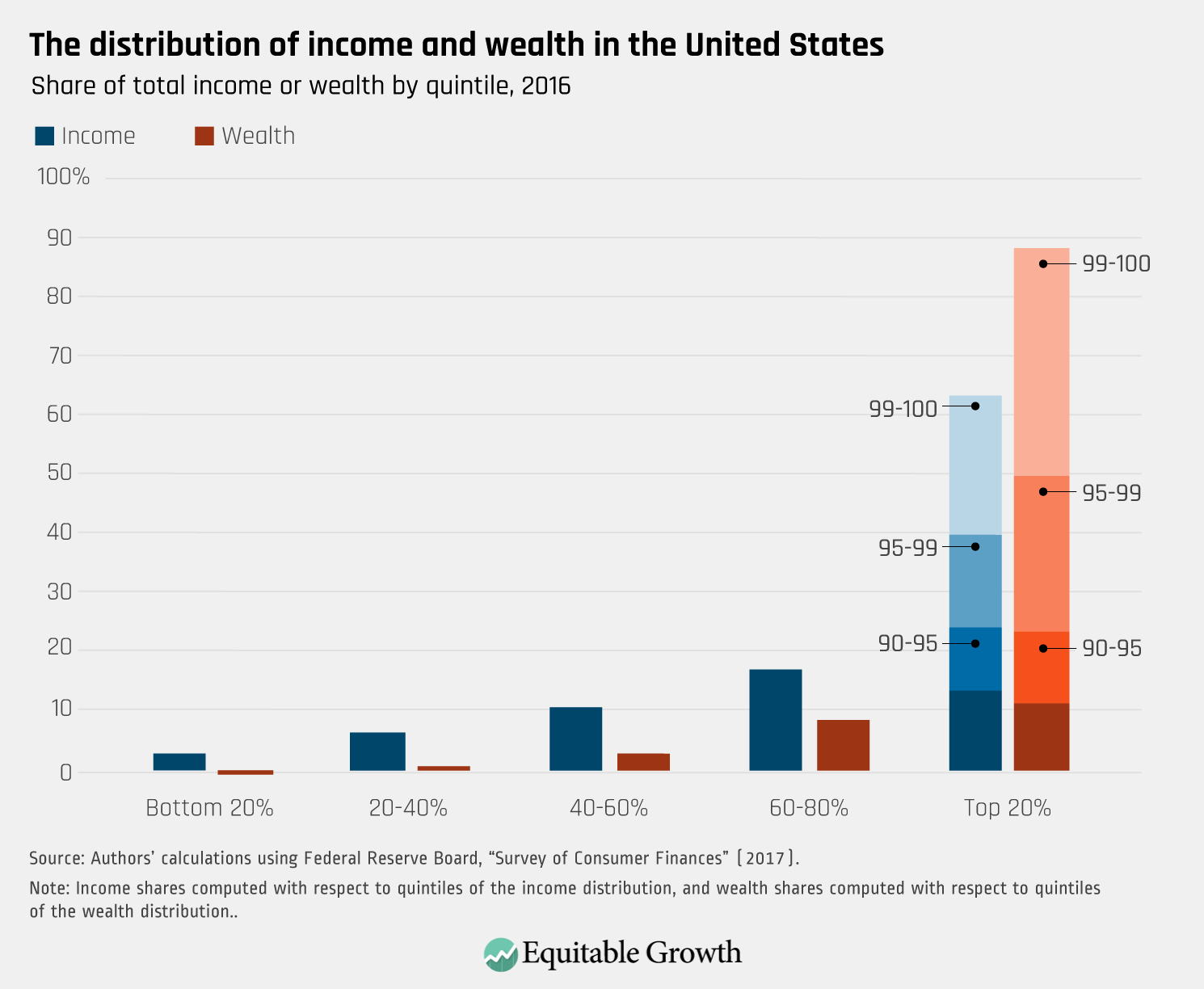
Take a look at the distribution graph from Washington Center for Equitable Growth. The income share  for each quintile is                                           and the wealth share is 
                1st ---     3%                                         1st ---     1%
                2nd ---    6%                                         2nd ---    1%
                3rd ---   10%                                         3rd ---    2%   
                4th ---   17%                                         4th ---    8%
                5th ---   63%                                         5th ---   88%       (top 1%  --- 38%)


For a clearer view of this income distribution, see State of Working America, Income, Table 2.4.  The  data in the Table 2.4 is from a CBO study of 2007, and it shows that the lower earning 40% earned 13.0% of all wage income when wage income amounted to only 54.3% of all income. That equates to 5.2% of the national income -- multiply 54.3 times 13% = 5.2 --  being earned as wages by the lower-earning 40%. Yes, it looks complicated, and it is, but actually fairly simple once you grasp the complex chart. 

Sources of pretax comprehensive income, by income group, 2007 (2011 dollars)


The most important fact here is that total wage income amounts to just $8.38 trillion, which in 2018 was only 47% of the total income ($17.8 trillion) reported by the BEA.gov Table 2.1, or just 56% of total income ($15.0 trillion) reported by the Congressional Joint Committee on Taxation (see page 34).  
Take the total wage income for the lower-earning half -- $1.2 trillion -- and it turns out to be just 8% of all income (Joint C. T.) or just 6.7% of all income (BEA). What is total income divided by all workers? $91,000, or $106,000. But the average for the lower half is $14,300. Pitiful. 

The market forces are destroying the market, you might say. A race to the bottom results in few being able to purchase necessities, a gradual enervation, debilitation, and sapping of economic vitality. !!!!  The crisis that is totally ignored, one would conclude. 

The Brookings Institute report “Meet the Low-Wage Workforce” examines the incomes of roughly half of U.S. workers, the low-earning half. It shows that $19,000 a year is the average income for 67% of workers who earn below the median wage income for all workers, $32,838. The other 33% are very low earning workers earning below $7,500 a year. If we take the total income in the economy, about $18.8 trillion, and divide that among the 168 million workers, we arrive at an average of $112,000 per worker. 

My essays of August and of December are easy reads, and the imbalanced state of the economy is simply explained. You might wish to read those two essays. 

The BLS shows that 69.5% worked full-time year-round in 2017. So around 50 million of the 165 million workers were less than f-t y-r. 
  
Many household budgets cannot fall back on savings to get through a "shelter in place" order. Without savings and without an income, many Americans are between a rock and a stone wall. A HUD.gov site says that 9% of Americans pay more than 50% of income on housing. A Harvard University study shows that 30% of Americans pay over 30% of their income on housing. Another Harvard University study found that 1 in 4 renters pay more than 50% of their income in rent. Workers in “non-essential” jobs no longer have incomes, they are directly affected by the work stoppage, and many rent their living quarters. 
__________________________________________
June 12, 2020, Insert -- A Survey from the U.S. Census, May 2020-                     how the nation is holding up.

The U.S. Census has conducted five flash surveys since the beginning of May, the Household Pulse Surveys. I’m looking at May 21 to 26, Food Table 2a, (and other tables) it says that 60% of all employed adults nationwide experienced a loss of “employment income”, either personally or a household member (that’s 119 million out of 198 million after subtracting 38 million “retired” and 14% in other categories). Questioned about “Reason for recent food insufficiency”, 61% reported “Couldn’t afford to buy more food”. (Food Table 4). And 49% report being “not at all confident” or “somewhat confident” when asked “Confidence in being able to afford food next four weeks.” And around 50% are “feeling nervous, anxious, on edge” and “not being able to stop or control worrying” and “feeling down, depressed or hopeless” and “having little interest or pleasure in doing things”. And another report from EPI (dot org) says 32.5 million, about a quarter of all, workers have filed for some form of  Unemployment Insurance. There’s some hope that these conditions will instigate a voter rejection of normality.
__________________________________________
We have staggering inequality. The U.S. is peculiarly bi-polar in the department of income and wealth. It may surprise many to know, and it surprised this writer, that the average wealth per household is $924,000. On March 12, 2020, the Federal Reserve reported in its Flow of Funds report, page 2, that total household net worth peaked at $118.3 trillion. Divided among the nation’s 128 million households that comes to $924K per household. Unfortunately 40% of households own just 0.1% of all wealth, states the Credit Suisse report on Global Wealth. Average wealth per adult in that group is about $2,000. 

The average yearly household income, not wealth, before taxes is over $140,000, states the Bureau of Economic Analysis, Table 2.1. But half of households have incomes below $64,000, and many of them much below $64,000. The per person annual “disposable personal income” after taxes is now $50,504 says the same BEA table. Does it surprise anyone to learn that $24,405 is the median income per person for all four person households? The average is $50,504, but half have less than $24,405 per person, and often much less than $24,405. Those in official poverty live with below $6,500 per person. See the U.S. Census hinc-01 table. The numbers are difficult to digest, but the incongruity is not. 

It’s a sad truth, that many Americans are unaware of the great disparities among U.S. households. The household medians, for both wealth and income, are far below the averages which are raised by the very high amounts at the tippy-tippy-top, the 1 percent.

The United Way charity reports in its ALICE report that 40% of Americans live with hardship or experience poverty. In a land where $50,000 of after-tax income per person is a fact, and over $400,000 of savings per adult is a fact, we have 40% who struggle to pay for necessities. It is a strain on the imagination. An income of $61,589 for a four person household, in 2020, is the ALICE Survival Budget income. This is 2.4 times the poverty official level. Meaning that the poverty level is much lower than the stressed out level. 

Will low income workers be able to pay for necessities over the next few months is an extremely critical and unanswered question. The nation is watching. We have the resources, the nation is very wealthy, but can and will we protect and support those who have no “spare tire”. 
______________________________________________________
An Update on June 6, 2020 
That was the end of the essay. On June 6, 2020, I'm adding a bit more. A 2016 article at The Atlantic magazine, “The Secret Shame of Middle-Class Americans — Nearly half of Americans would have trouble finding $400 to pay for an emergency. I’m one of them” contains this revelation of the fragility of about 60% of U.S. household: 
“He [professor Edward N. Wolff] found that in 2013, prime-working-age families in the bottom two income quintiles [from the first to the 40th percentile] had no net worth at all and thus nothing to spend. A family in the middle quintile, with an average income of roughly $50,000, could continue its spending for … six days. Even in the second-highest quintile [60 to 80], a family could maintain its normal consumption for only 5.3 months. Granted, those numbers do not include home equity. But, as Wolff says, “it’s much harder now to get a second mortgage or a home-equity loan or to refinance.” So remove that home equity, which in any case plummeted during the Great Recession, and a lot of people are basically wiped out. “Families have been using their savings to finance their consumption,” Wolff notes. In his assessment, the typical American family is in ‘desperate straits.’”
This article is rich with insights about financial insecurity, such as this finding: 
“. . . and the study by Lusardi, Tufano, and Schneider found that nearly one-quarter of households making $100,000 to $150,000 a year claim not to be able to raise $2,000 in a month.” And, “About 38 percent of households carried some debt, according to the analysis, and among those, the average was more than $15,000.” And, “The American Psychological Association conducts a yearly survey on stress in the United States. The 2014 survey—in which 54 percent of Americans said they had just enough or not enough money each month to meet their expenses—found money to be the country’s No. 1 stressor.” The author, Neal Gabler, finishes with, “What so many of us have been suffering for so many years may just seem like a rough patch. But it is far more likely to be our lives.”

And the Federal Reserve sponsors many reports on financial status of Americans, one being this short one, 

"Money in the Bank? Assessing Families' Liquid Savings using the Survey of Consumer Finances"

It found that only 40% of households have accumulated a 'rainy day' account large enough to weather a 3 month income hiatus, and the three month expenditure amount sums to $9,315. That leaves 60% with insufficient funds in their savings safety net. Only 28% have savings capable of surviving a 6 month income drought. But, a positive sign, many households have access to "quasi-liquid assets". In addition to liquid savings, some families have savings in "quasi-liquid" accounts, like account-type retirement plans (401k or IRA), certificates of deposit or savings bonds, or cash-value life insurance accounts. This type of savings can be accessed if needed, but there may be limitations, penalties, or taxes that have to be paid.  
These accounts double the number of households able to sustain a long-term collapse of income. See graph number three. If only 40% have enough for 3 months, another 30% have enough "quasi-liquid" savings to cover the 3 month shortfall. But the simple fact remains, after three months of no income, about 70% of Americans will be up the creek without a paddle, and their retirement or insurance savings will be gone. 

___________________________________________________

About Recovery Proposals 

There are appearing many plans, and I'll comment on them as I get a chance. Today is June 6, 2020. The first I am interested in is by professor Pavlina Tcherneva who advocates for public direct job creation at the Levy Economics Institute. 
"Guaranteeing Employment During the Pandemic and Beyond", May 2020, 
"When the CARES Act loan guarantees (with already extremely weak job protections) expire and firms face continued reduction in demand, the layoffs that did not take place during the pandemic will happen when the economy “reopens.” Whatever cash assistance we provide to families to keep them afloat now, millions of them will be scrambling for the pitifully scarce jobs of the postpandemic world. And we know what many of those jobs will be: poorly paid, with no benefits or basic employment protections, much like the ones “essential” workers currently have (the delivery drivers, grocery store clerks, and sanitation staff). While lending and cash assistance help firms and families pay the bills, they are not job creation policies. They are not even reliable job protection policies."